Simulation

Supply Chain
Unify demand, inventory, and supplier signals to simulate impact before commitments are locked in.
Workflow 1 — Supplier Dependency Heatmap
Rows = regions · Columns = risk factors · Colour = risk (green → amber → red)
48%
27%
64/100
+18%
2 critical single points of failure identified
Supplier risk mitigation actions
Causal timeline
Supplier Dependency Heatmap
Risk baseline feeds inventory optimisation.
Inventory → Buffers
Optimised buffers feed SKU-level recommendations and WC impact.
Inventory Risk vs Working Capital
Optimised buffers feed sourcing network reallocation.
Sourcing → Replenishment
Reallocation feeds replenishment rules and supplier contracts.
Sourcing Network Reallocation Map
Replenishment and risk profiles synced to ERP.
Establishes structural fragility baseline
Supplier risk scores · Dependency flags · Classification tiers








Understand the True Cost of Disruption. Simulate delays, cost increases, or capacity constraints and see their downstream impact on revenue, margin, and cash.
Adopted by forward-thinking executive teams, Nimbus connects finance, operations and commercial data into a unified causal model — empowering leaders to simulate strategy, quantify ROI, and act with zero decision latency.
Simulation
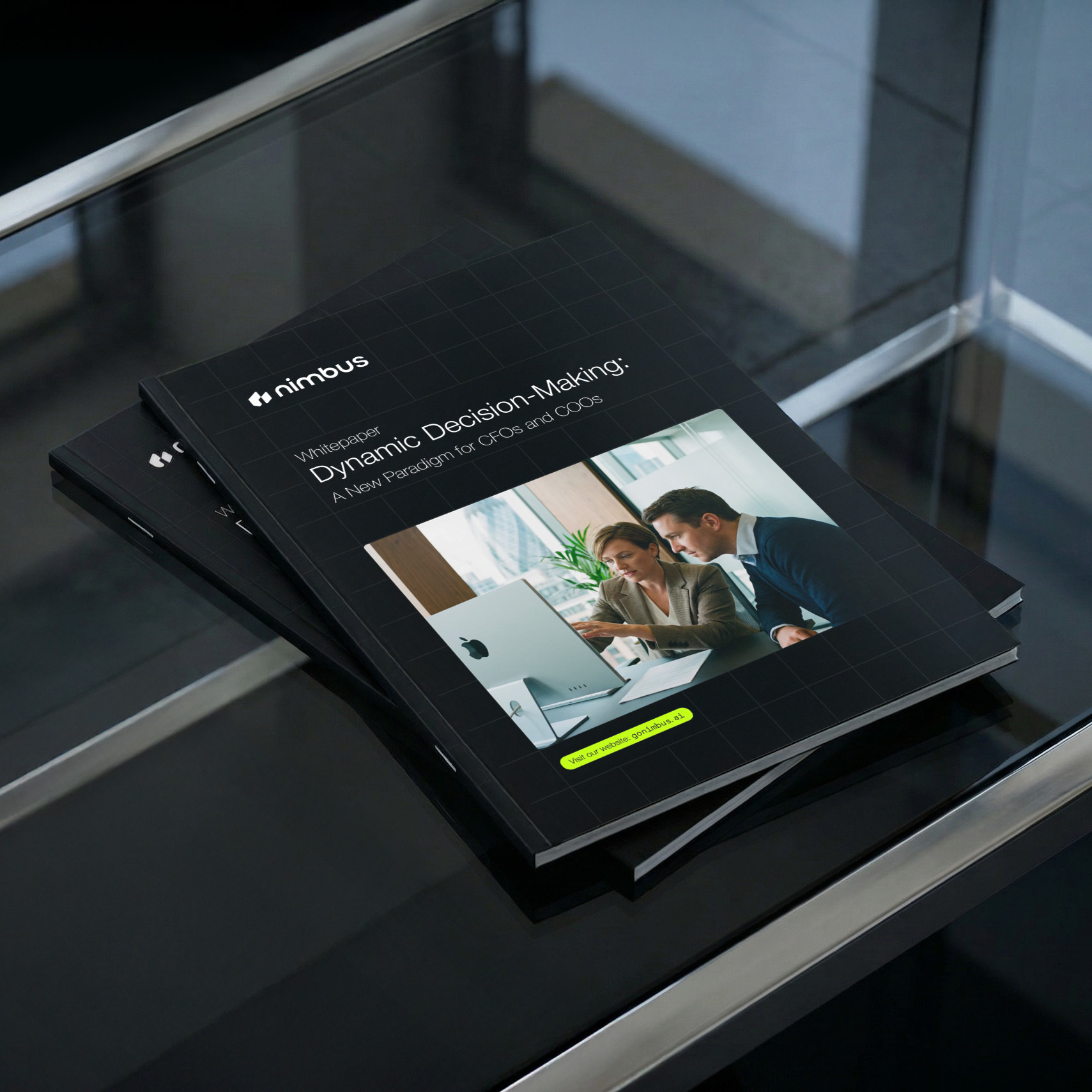
A New Paradigm for CFOs & COOs
Intelligence Infrastructure
Every operation shares organizational context. Every decision is traceable. Every outcome propagates. Nimbus connects your business processes through a shared model of cause and effect.
Learn moreNimbus turns the complexity of modern organisations into a living system where agents, workflows and data continuously adapt to guide better decisions.
How simulation-driven decision-making and digital twins can help rebuild trust and resilience in global agri-food supply chains.
Senior executives at leading OEMs recognize that today's market pressures – surging EV competition, software-defined vehicles, volatile supply chains, and AI-driven planning – demand unprecedented cross-functional collaboration. Yet most product, engineering, supply-chain, sales and marketing teams remain trapped in silos, each with its own data, assumptions and priorities.
Traditional FMCG product research methods increasingly fall short in today's fast-moving markets. Companies often rely on static dashboards, quarterly reports and one-off surveys that only capture lagging indicators of consumer behavior and market conditions.