Simulation

Finance
Connect planning, channel, and inventory performance into one decision workflow that updates in real time.
Workflow 1 — Variance Signal & Attribution
Actual (solid) vs plan (dashed) · Amber = variance drivers · Decomposed by pricing, volume, timing
−4.3%
88%
+2.1%
+3.7 mo
Variance drivers by segment
Causal timeline
Variance Signal & Attribution
Variance signal feeds attribution and driver decomposition.
Attribution → Correction
Attribution feeds staged correction plan and owner assignment.
Budget Correction & Workforce Alignment
Budget updates feed spend allocation by segment.
Allocation → Guardrails
Allocation feeds guardrail enforcement and approval workflows.
Spend Allocation & Guardrails
Spend allocation committed to Workday / ERP. Closed-loop complete.
3 high-impact variance drivers identified
Revenue: enterprise segments. Margin: discount mix, expedited fulfilment. Staged correction plan.








Eliminate Manual Reconciliation and Reduce Audit Burden. Automate internal stock reconciliations, surface discrepancies instantly, and materially lower external audit costs through full decision traceability.
Adopted by forward-thinking executive teams, Nimbus connects finance, operations and commercial data into a unified causal model — empowering leaders to simulate strategy, quantify ROI, and act with zero decision latency.
Simulation
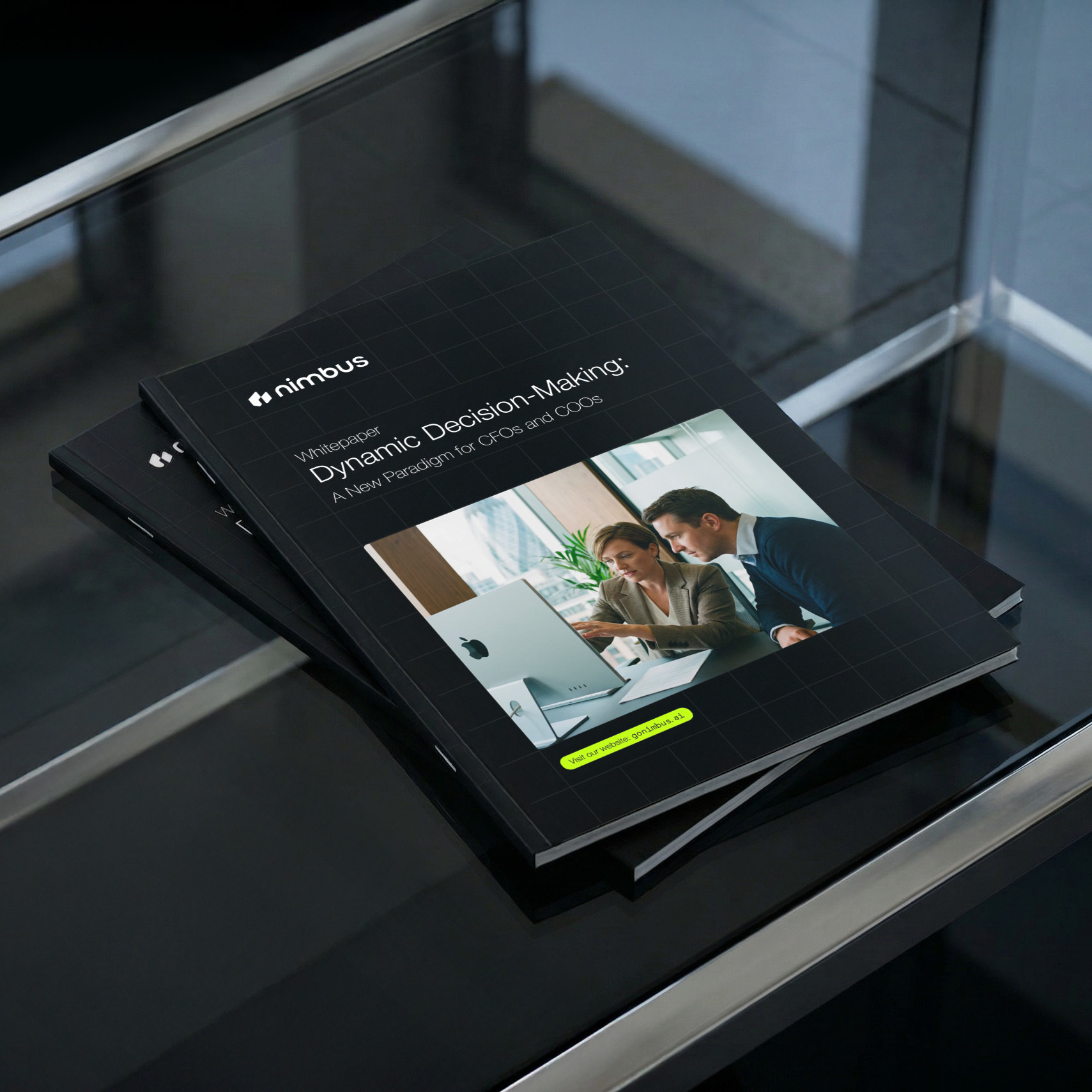
A New Paradigm for CFOs & COOs
Intelligence Infrastructure
Every operation shares organizational context. Every decision is traceable. Every outcome propagates. Nimbus connects your business processes through a shared model of cause and effect.
Learn moreNimbus turns the complexity of modern organisations into a living system where agents, workflows and data continuously adapt to guide better decisions.
How simulation-driven decision-making and digital twins can help rebuild trust and resilience in global agri-food supply chains.
Senior executives at leading OEMs recognize that today's market pressures – surging EV competition, software-defined vehicles, volatile supply chains, and AI-driven planning – demand unprecedented cross-functional collaboration. Yet most product, engineering, supply-chain, sales and marketing teams remain trapped in silos, each with its own data, assumptions and priorities.
Traditional FMCG product research methods increasingly fall short in today's fast-moving markets. Companies often rely on static dashboards, quarterly reports and one-off surveys that only capture lagging indicators of consumer behavior and market conditions.